Friday, 28 February 2014
Wooden Storage Shed For A Lawnmower
Over the last few weeks, during periods of heavy rain, Ady and Graham have built a wooden storage shed for a lawnmower. Using spare pieces of feather edge board, left over from the building of the potting shed, see blog entry 19th October 2012 'It Now Looks Like A Shed', they designed and built this storage shed. The need for the shed was highlighted following the completion of a risk and manual handling assessment undertaken for the transporting of a heavy lawnmower up the steep steps to the garden above. The mower can now remain in situ preventing the need for the carrying of this heavy, awkward load.
Wednesday, 26 February 2014
Coppicing Birch
| Newly Planted 2 Year Old Birch Trees |
Every year the team take delivery of a trailer load of coppiced birch to make the supports for the plants on the herbaceous border, for an example of the supports made see blog entry 15th March 2011 'Basket Weaving'. Today Ali went on a training day at The Harcourt Arboretum to learn about this ancient form of woodland management, Coppicing, that produces these plant supports. Working with the staff at the arboretum they started the day in a new area of coppice, planting 2 year old birch trees which, in 5 years time, will be cut down. Each tree was supported by a bamboo cane and protected by a clear plastic tree guard.
Having helped to create a woodland for the future, they then moved onto the coppicing of a small birch woodland that was planted in 2000 and is cut on a three to five year rotation. This rotation can increase the biodiversity in the woodland, the clearance results in the variation of light levels reaching the woodland floor as well as altering the number of stools, size and age of the trees.
| Birch Coppice |
Coppicing is the repetitive cutting down of multi stemmed trees, in this case birch, creating a stump, a coppice stool, which will regrow from dormant buds or root buds producing new wood for future. The stems are cut using a saw, making a sloped cut which is thought to shed water and prevent fungal decay. The part of the woodland coppiced is called a 'coupe', also known as a sale, fell, cant, panel or burrow depending on locality.
| Birch |
| Coppice Stool |
| Underwood |
Joined by volunteers the 'coupe' is methodically cleared. As the team go deeper into the woodland, the cut down wood in called 'underwood', the further they have to drag it back to the path for collection, being careful not to trip over the newly created stools!
| Cleared Birch Coppice |
| Underwood |
Monday, 24 February 2014
Goodbye Sophie
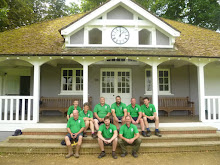
| (L-R) Ali, Ady, Kieron, Graham, Simon, Sophie, Joss, Callum. |
Today the team said "goodbye" and "thank you" to Sophie who, for the last 14 months, has been volunteering on Mondays in the gardens. Sophie it has been a real pleasure to work with you and wish you all the best with your future career in horticulture.
The Provost's Drive Border
Two years ago the team spent three days clearing the overgrown border next to the Provost's drive, see blog entry 5th March 2012 'The Provost's Drive'. Since then the weeds, mainly bindweed, have been controlled by regular spraying with the weedkiller Glyphosate, the final application being last summer.
Today Ady, Graham and Callum planted the border with the winter flowering shrub, Sarcococca confusa, Sweet Box, which, in a few years time, will fill the air with their fragrance, see blog entry 5th February 'Sweet Smell Of Winter Flowering Shrubs'. Once all the Sarcococca had been planted the border was finished off with the addition of a leaf mould mulch.
Thursday, 20 February 2014
Planting A New Yew Hedge
Today's task, to prepare the ground and plant 75 young, 2 foot tall Yew trees to create a hedge along the side of the orchard next to the car park.
Before the turf could be removed the area for the new hedge had to be measured out and guide lines put in place.
The turf was then cut into small squares using an edging iron, lifted with a turfing iron, placed into a trailer and taken to the compost area to make a turf stack.
As the turf was removed a trench was dug and the soil placed on boards to one side.
Once the trench had been dug the bottom was forked through to break up the base and a layer of leaf mould added. A guide line was then placed along the centre of the trench. The young yew hedging plants, purchased from Penwood Nurseries Ltd, were then placed into the trench, a few at a time, along the centre line and the soil back filled around them.
By the end of the day, through sunshine and rain, a new hedge had been created between the orchard and the car park.
Wednesday, 19 February 2014
Cutting The Grasses Down
The grasses in the Serpentine Border have been battered in the recent heavy rain and gale force winds making them look very untidy. Simon and Ali spent the morning cutting the grasses down with a hedge cutter releasing the box balls from their grassy covering and exposing the newly emerging flowers of the Muscari, which will soon create a river of blue meandering through the surrounding hard landscaping.
Wednesday, 12 February 2014
Mulching Borders
| Goldfish Bowl |
Since Monday of last week, Ady, Graham and Callum have, weather permitting, been clearing out a very old leaf pit which is full of lovely dark brown, crumbly leafmould. Having spent years rotting down, the leaves are now ready to be spread on the college borders as a mulch. Starting by the Casson Building, also known as The Goldfish Bowl, they have worked their way round the borders that surround the Nuffield Lawn finishing in the centre of the lawn mulching amongst the snowdrops.
| Lindbury Building |
| Herbaceous Border (right) |
| Herbaceous Border (left) |
| Nuffield Lawn |
Subscribe to:
Posts (Atom)